Table Of Content

Please note that Google Fonts does not accept user submissions of finished icon designs! There are fairly strict guidelines for Material icons, plus Google has upstream source files from which this repo is generated. Therefore, Google does not accept pull requests for icon files (whether new icon suggestions, or fixes for existing icons). Concepts are appreciated—just don’t design SVGs and submit them via pull request. By default, images' semantic content is set to unspecified. If you do not want an icon to ever be mirrored, you need to explicitly set it to be forceLeftToRight.
Material Icons Guide
The icons are packaged into a single font so that web developers can easilyincorporate these icons with only a few lines of code. IOS has the concept of a UISemanticContentAttribute that is attached to each view. This can be unspecified, forceLeftToRight, forceRightToLeft, playback or spatial. IOS uses this value and the (left-to-right (LTR)/RTL setting of the device presenting the interface to determine the effectiveLayoutDirection of the view.
Facebook and Instagram is finally getting themed Material icons for Android - Neowin
Facebook and Instagram is finally getting themed Material icons for Android.
Posted: Mon, 23 Oct 2023 07:00:00 GMT [source]
Git repository
The material icon font is the easiest way to incorporate material icons withweb projects. The top and bottom edges of material elements provide a sense of depth and surface. All edge distances are measured from an element's interior edge. The left, right, and bottom edges do not have a tint applied. The left, right, and top edges do not have a shade applied.
Material Design Light
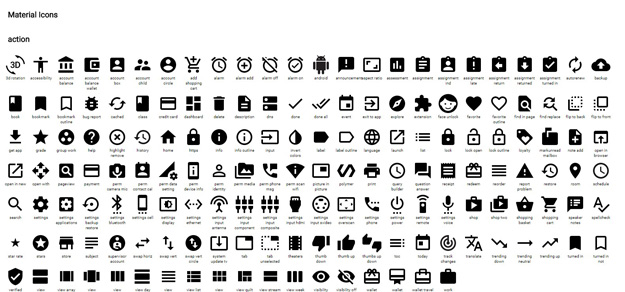
Google’s Material Symbols are now available leveraging variable font technology. Tinted edges highlight the top edge of elements (the left, right, and bottom edges are not tinted). Keyline shapes are used across all app icons to maintain consistent visual proportions. Android O icons represent your app on a device's Home and All Apps screens.
Icon content must remain inside of the trim area (the total area of the graphic). If optical corrections are necessary, only use the consistent geometric forms on which all other icons are based. Extreme scenarios that call for subtle tweaks add to the legibility of an icon. Instances where complex details are unavoidable require adjusting metrics. Any scaling done to the original will scale the image up or down proportionally. By maintaining the unit ratio, you preserve sharp edges and correct alignment when the scale is reduced.
Scored material elements have the illusion of depth without losing their geometric form. Don’t embellish colored elements with any edges or shadows. A soft shadow around all edges of a raised material element. Shade is the mixture of a color with a darker hue, which darkens the original color. SVG files are available in the directory "svg", followed by icon name. Each directory contains up to 5 SVG files, one for each icon variation.
The product icon grid has been developed to facilitate consistency and establish a clear set of rules for the positioning of graphic elements. This standardization results in a flexible but coherent system. Use these guidelines as a starting point to ensure that your product icon colors and key elements reflect your brand identity. We have made these icons available for you to incorporate into your products under the Apache License Version 2.0. Feel free to remix and re-share these icons and documentation in your products.We'd love attribution in your app's about screen, but it's not required.

Folded material elements are skewed, having greater dimension. Spot colors should be avoided, so as to avoid altering or misrepresenting key elements. Each color reacts differently when tints and shades are added. The color of every edge tint, edge shade, and shadow needs to be adjusted for each color that lies behind it. To ensure color harmony, follow the appropriate value for each.
Android 15 prepares revamped status bar with new icons and haptics - Android Authority
Android 15 prepares revamped status bar with new icons and haptics.
Posted: Tue, 02 Apr 2024 07:00:00 GMT [source]
Thegit repository contains the complete set of Material Symbols in SVG format. You can match grade levels betweentext and symbols for a harmonious visual effect. For example, if the text fonthas a -25 grade value, the symbols can match it with a suitable value, say -25. If mirroring the icons in code is not an option you can use ImageMagick to horizontally mirror the image.
For example, forward points to the left, and backwards points to the right. However, be mindful that the context in which the icon is placed also influences whether an icon should be mirrored or not. The imageset contains the single, double and triple density images (1x, 2x, 3x) so they work on all known iOS screen densities. The material icons are available from the git repository which contains the complete set of icons including all the various formats weare making available. Material design system icons are simple, modern, friendly, and sometimesquirky. Update with latest icons, new icon fonts for additional material styles.
2dp of padding must surround the live area, making the total icon size 48dp. The design of system icons is simple, modern, friendly, and sometimes quirky. Each icon is reduced to its minimal form, with every idea edited to its essence. The designs ensure readability and clarity even at small sizes.
Do use consistent stroke weights and squared stroke terminals. Consistent stroke weights are key to unifying the overall system icon family. Maintain a 2dp width for all stroke instances, including curves, angles, and both interior and exterior strokes. By using these core shapes as guidelines, you can maintain a consistent visual proportion throughout the system icons. For dense layouts on desktop, icons may be scaled down to 20dp with 2dp of padding surrounding the icon. The icon grid has been developed to facilitate consistency and establish a clear set of rules for the positioning of graphic elements.
A top light cast on material elements creates a contact shadow while highlighting the top and bottom edges. An angled light reinforces the sense of surface across the elements. Android expects product icons to be provided at 48dp, with edges at 1dp. When you create the icon, maintain the 48-unit measure, but scale it to 400% at 192 x 192 dp (the edge becomes 4dp).


No comments:
Post a Comment